|
|
此文章由 诗篇23 原创或转贴,不代表本站立场和观点,版权归 oursteps.com.au 和作者 诗篇23 所有!转贴必须注明作者、出处和本声明,并保持内容完整
本帖最后由 诗篇23 于 2014-2-28 14:58 编辑
请大家给我些评分,我在努力积分。谢谢
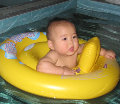
我在隔壁帖子里写了怎样更好的让宝宝乐意做Tummy Time。也可以看下面的图,加个垫子或在家长腿上。
这个和趴 和爬都是对宝宝发育很重要的环节。physio和OT都知道。
千万不要让宝宝过早走路,不要跳过爬的阶段。
做为OT看过很多正常孩子,但是有写字画画握笔等上肢问题,就是因为当初没有足够时间爬。爬对上肢力量,肩膀手肘手腕手指力量都是锻炼。
新加: 爬也是锻炼脑部发育的重要途径。There is growing evidence that crawling plays a role in the development of an infant’s strength, balance, spinal alignment, visual-spatial skills, and socio-emotional development. 它还对平衡,脊椎定位,视觉空间技能,社交情绪发展有很大关系。
文章这里可以看http://www.babble.com/baby/crawling-is-crucial/
I work as a pediatric occupational therapist, so my ears always perk up when I hear parents comment about their child’s motor skill development. I recently heard a parent proudly exclaim, “My baby never crawled. She was an early walker!” I cringed just a bit.
I was taught in therapy school that the experience of crawling plays a critical role in infant development, and that it is not good for a baby to skip this milestone. Yet, just as this mother said, we often hear of infants totally bypassing the crawling phase to go straight to walking. Whether or not crawling truly plays a significant role in infant development is a matter of debate among some medical and research professionals, but many pediatricians and therapists firmly believe that parents should encourage their little ones to crawl on all fours, at least for a brief period of time.
Why? There is growing evidence that crawling plays a role in the development of an infant’s strength, balance, spinal alignment, visual-spatial skills, and socio-emotional development.
Crawling engages the baby’s whole body. When a baby crawls, he has to use his arms and legs to lift his trunk off of the floor. While working against gravity to move about, he is strengthening the muscles in his trunk, shoulders, arms, legs, and hands. Holding his wrists in an extended position and bearing weight on his hands while crawling develops the arches in his hands, influencing fine motor skill development. The action of crawling also plays a role in forming the curves of the spine, which are important for future spinal function.
Crawling also influences the development of visual skills. When crawling from one place to another, a baby frequently uses her “distance vision” to look ahead and set her sights on a goal. She then looks back at her hands, which requires her to adjust the focus of her eyes. These adjustments are good for training the eye muscles and improving binocular vision, which is the ability to use the eyes together as a team. Efficient binocular vision is necessary for the future skills of reading and writing.
Crawling also influences an infant’s socio-emotional development. This means that positive and negative emotions are expressed more frequently and intensely as this skill develops. In fact, infants only develop a fear of heights after several weeks of experience with crawling. As a baby begins to move about independently, she has the freedom to set new goals, which results in increased opportunities to fulfill those goals, as well as new possibilities for failure. Setting goals and reaching them or failing at them affects emotional development and ultimately impacts a baby’s sense of autonomy and confidence.
When a baby crawls in the traditional manner, the right and left sides of the brain and body must work cooperatively together. This action is called cross-lateral integration, and it builds a foundation for skills that require motor coordination. However, many infants get around by rolling, bottom scooting, or crawling commando-style, and that is just fine. You can always play crawling games with your child later on to provide experience with cross-lateral integration.
---------------------------------------
http://www.medcentral.org/main/Whatssoimportantaboutcrawling.aspx
Some children will only crawl for a short period of time, crawl "funny" or skip this milestone completely. The question this raises is, "Is crawling really that important?"
The answer is, "Yes." Along with strengthening the trunk, shoulders and hand muscles, the mechanics of crawling stimulate different areas of the brain that are important for future learning. When a child begins crawling, this repetitious movement helps stimulate and organize neurons, allowing her brain to control cognitive processes such as comprehension, concentration and memory. When an infant crawls, she visually determines where she wants to go and physically moves in that direction. Her hands become the guides and the child's first test of hand/eye coordination becomes established. This skill set is used later in life for reading, writing and sports activities.
|
本帖子中包含更多资源
您需要 登录 才可以下载或查看,没有帐号?注册
x
|
 丰田Camry 汽车收音机升级安装DVD/蓝牙/GPS一体机 (2015-8-3) Alpha2003



 发表于 2013-10-24 20:17






 学习
学习